Bird size profile
Golden Eagle
Aquila chrysaetos
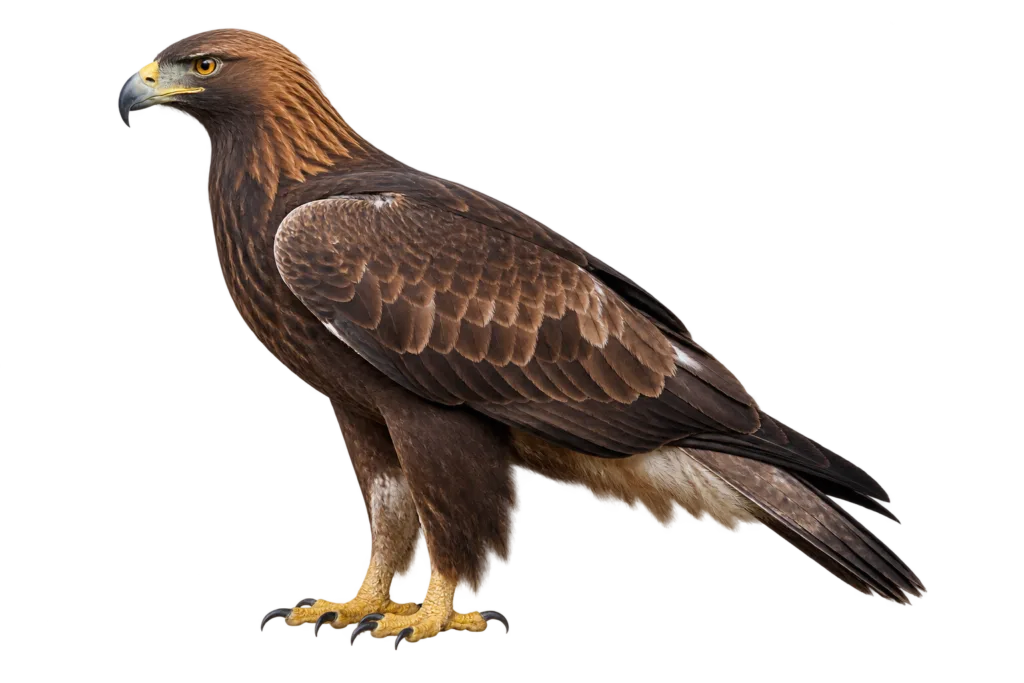
Size at a glance
How big is a Golden Eagle?
True-scale visual
Golden Eagle compared with a 175 cm person
When a transparent species asset and body-length data are available, BirdSize places the real bird asset and the fixed human reference on one mathematical centimetre scale.
Compare
Compare Golden Eagle with another bird
Search by common or scientific name.
Morphology
Detailed measurements
Taxonomy
Classification
The Golden Eagle (Aquila chrysaetos) combines a large body with long, broad wings and an unusually long-tailed profile for an eagle of its size. A widely used North American measurement range places body length at 27.6–33.1 in (70–84 cm), wingspan at 72.8–86.6 in (185–220 cm), and body mass at 6.6–13.5 lb (3.0–6.125 kg). These figures cover birds of different sexes and individual sizes rather than describing one standard Golden Eagle.
Why Golden Eagle Size Covers Such a Wide Range
A large Golden Eagle can be much heavier than a small individual while both remain well within the normal range for the species. Sex accounts for much of this difference. Golden Eagles show reversed sexual size dimorphism, the pattern common among many birds of prey in which females are larger than males.
Geography also matters. Golden Eagles occur across a huge part of the Northern Hemisphere, and traditionally recognized populations and subspecies show some variation in body size and coloration. Published field references therefore do not always give identical upper and lower limits. The measurement range is more useful than treating a single maximum length or weight as a fixed limit for every Golden Eagle.
Females Are Noticeably Heavier Than Males
Male and female Golden Eagles have very similar plumage, so body size is one of the clearest physical differences between the sexes. Published mass ranges show how large that difference can become.
The ranges overlap, which is important when judging a bird in the field. A heavier male can fall within the lower part of the female range. Size by itself therefore cannot reliably determine the sex of every individual, especially without a known bird beside it for comparison.
Wingspan Does Not Tell the Whole Story
A wingspan approaching or exceeding two meters makes the Golden Eagle an imposing bird, but its proportions are often more useful than the span itself. The wings are broad and long, while the head appears relatively small. The tail extends well behind the body and projects farther behind the wings than the head projects in front.
- Wings: long and broad, with separated primary feathers forming visible “fingers” at the tips.
- Tail: relatively long for such a large eagle and an important part of the flight silhouette.
- Head: comparatively small, without the heavy forward projection associated with some other large eagles.
- Soaring posture: the wings are often held slightly raised rather than completely flat.
These features can make a Golden Eagle look long and balanced in flight rather than simply bulky. They also remain useful when distance makes an accurate estimate of wingspan impossible.
The Legs Reinforce the Golden Eagle’s Distinctive Build
Golden Eagles have feathers extending down the legs to the toes. This separates them structurally from Bald Eagles, which have exposed yellow lower legs. The feet are large and equipped with strongly curved talons, while the bill is deeply hooked but appears less oversized in relation to the head than the bill of a Bald Eagle.
Plumage changes with age without removing these structural cues. Adults are mainly dark brown with golden-brown feathers on the crown and nape. Younger Golden Eagles can show concentrated white areas in the wings and a white base to the tail. When color is difficult to judge, the combination of long wings, long tail, relatively small head, feathered lower legs, and large overall scale provides a stronger picture of Golden Eagle morphology than any single measurement.
Data
Measurement sources
- Data status
- Measured
- Size measurements
- Cornell Lab of Ornithology – All About Birds
- Morphology source
- AVONET — Tobias et al. (2022)
- Morphology dataset
- AVONET v7 — BirdLife taxonomy
- Morphology dataset license
- CC BY 4.0
Full source links, dataset definitions, licensing details and measurement methodology are maintained on the Data Sources & Methodology page.