Bird size profile
Greater Flamingo
Phoenicopterus roseus
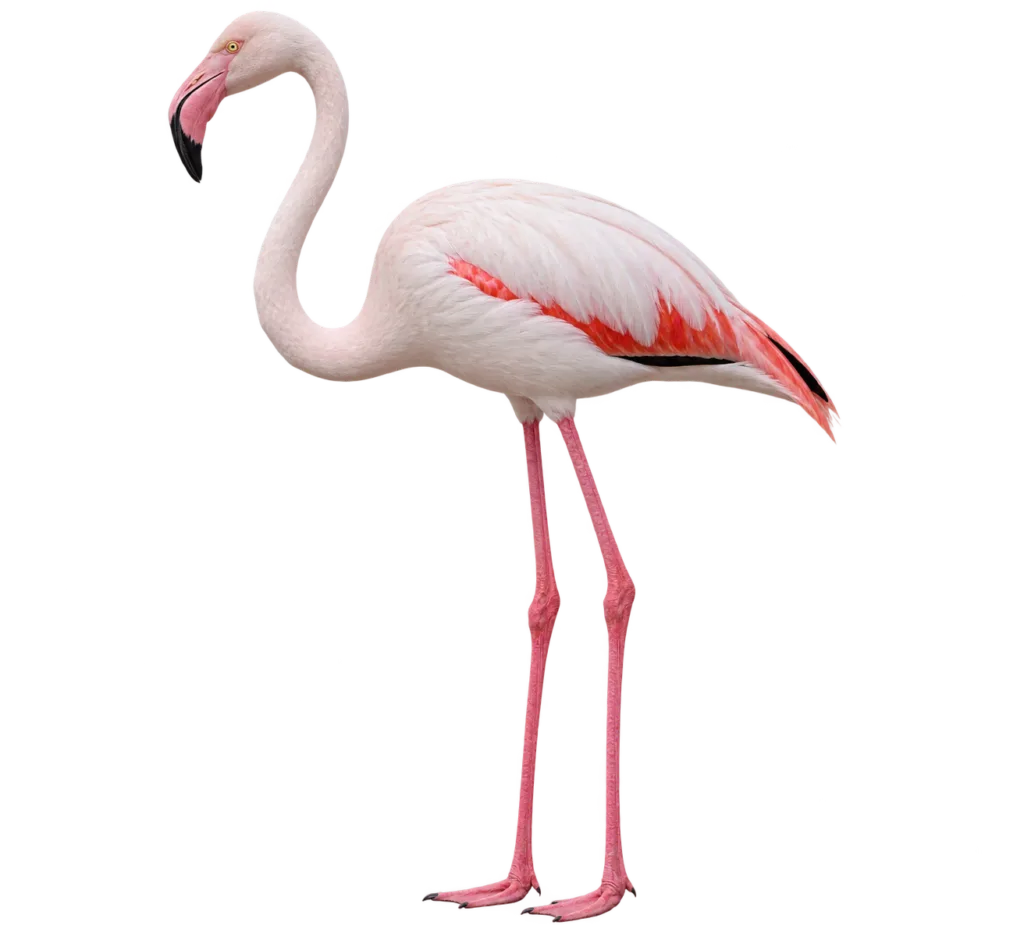
Size at a glance
How big is a Greater Flamingo?
Compare
Compare Greater Flamingo with another bird
Search by common or scientific name.
Morphology
Detailed measurements
Taxonomy
Classification
The Greater Flamingo (Phoenicopterus roseus) is the largest and tallest living flamingo species. Its size comes less from a bulky body than from its unusually elongated proportions: very long legs, a long flexible neck, and narrow wings carried on a relatively compact torso.
Why a Greater Flamingo Looks So Large
Published field measurements place Greater Flamingo body length at about 120–125 cm, while the wings can span roughly 140–187 cm. Body mass is much more modest than the bird’s height might suggest, commonly falling within only a few kilograms.
The contrast makes sense when the bird is viewed from the side. Much of its vertical reach comes from the legs and neck rather than the chest and abdomen. The body itself is relatively streamlined. A standing flamingo can therefore appear exceptionally tall without having the heavy build associated with many other large birds.
Values described as body length, total length, standing height, and wingspan measure different parts or orientations of a bird. A published body-length figure should not automatically be treated as the bird’s exact vertical height when standing.
Male and Female Size Overlap
Male and female Greater Flamingos have essentially the same plumage pattern, so color is not a reliable way to separate the sexes. Size provides a stronger clue. Males are larger on average, although individual measurements overlap enough that body size alone does not identify every bird correctly.
Research based on measured Greater Flamingos has found the male–female difference in several parts of the body. Leg measurements and body mass show clearer separation than wing length in some datasets. Growth studies also show that the difference develops while young birds are still maturing rather than appearing only after full adult plumage is reached.
This creates an important distinction when comparing two adults. A noticeably tall bird beside a smaller individual may be male, but a small male can still fall within the size range of a large female. The species does not divide into two clean male and female size classes.
The Wings Change the Bird’s Shape in Flight
At rest, much of the wing is folded against the body, making the torso look much smaller than the bird’s full wingspan suggests. Once the wings open, their long, narrow shape becomes clear. The black flight feathers also form a strong contrast with the red and pink wing coverts.
Greater Flamingos fly with the neck extended forward and the legs trailing behind. This produces a very different outline from a heron, which normally retracts its neck in flight. The flamingo’s visible length in the air therefore extends well beyond the body at both ends.
Wingspan describes the distance between the extended wingtips. It does not include the added visual length created by the outstretched neck and legs. For that reason, a flying Greater Flamingo can look longer and more slender than its wingspan figure alone would suggest.
Bill Shape Does Not Simply Follow the Male–Female Size Difference
The downward-bent bill is one of the most prominent structures on a Greater Flamingo, but recent morphometric work shows that its shape follows a different pattern from general body size.
A 2026 study examined standardized bill images from 40 adult Greater Flamingos of known sex. Male and female bill shapes overlapped strongly, with sex failing to explain a clear difference in either dorsal or lateral shape. The study did find evidence that some dorsal bill-shape variation changes with overall bill size.
Greater Flamingo males tend to be larger-bodied than females, yet adult males and females do not form separate bill-shape groups. Individual size and allometric change explain more of the observed bill variation than sex-specific bill form.
This matters when interpreting proportions. A larger Greater Flamingo should not be pictured simply as a uniformly enlarged version with a characteristically different male bill. Different anatomical structures can vary according to different patterns.
Young Flamingos Grow Into the Long-Legged Adult Proportions
Young Greater Flamingos are not merely gray versions of finished adults. Their external appearance changes through several stages, while measurements of the legs and other structures continue to develop.
Recent growth research using known-age chicks found that tarsus length changes predictably enough during part of early development to help estimate age. The study also found different growth patterns between the sexes: females reached parts of the growth curve sooner, while males developed toward a larger final leg size.
Plumage can make the age difference even more obvious than size. Juveniles are mainly pale gray or whitish, with grayish legs and a duller bill. Pink feathers appear progressively, and intermediate plumages can persist into the second and sometimes third year. A younger bird may therefore look less imposing than a strongly colored adult even when much of its skeletal growth has already occurred.
How Much Larger Is It Than a Lesser Flamingo?
The size difference is especially useful where Greater and Lesser Flamingos occur together. Greater Flamingos are commonly listed at about 120–125 cm in body length with a 140–187 cm wingspan. Lesser Flamingos are much smaller, around 80–90 cm long with a wingspan near 95–100 cm.
The difference is not limited to a single measurement. Greater Flamingos combine longer legs, greater body length, and substantially longer wings. Their bill is also mostly pink with a restricted black tip, while the Lesser Flamingo has a darker, differently patterned bill. In a mixed flock, these proportional and structural differences are usually more dependable than judging pink coloration alone.
Data
Measurement sources
- Data status
- Measured
- Size measurements
- AVONET — Tobias et al. (2022)
- Morphology source
- AVONET — Tobias et al. (2022)
- Morphology dataset
- AVONET v7 — BirdLife taxonomy
- Morphology dataset license
- CC BY 4.0
Full source links, dataset definitions, licensing details and measurement methodology are maintained on the Data Sources & Methodology page.