Bird size profile
Northern Cardinal
Cardinalis cardinalis
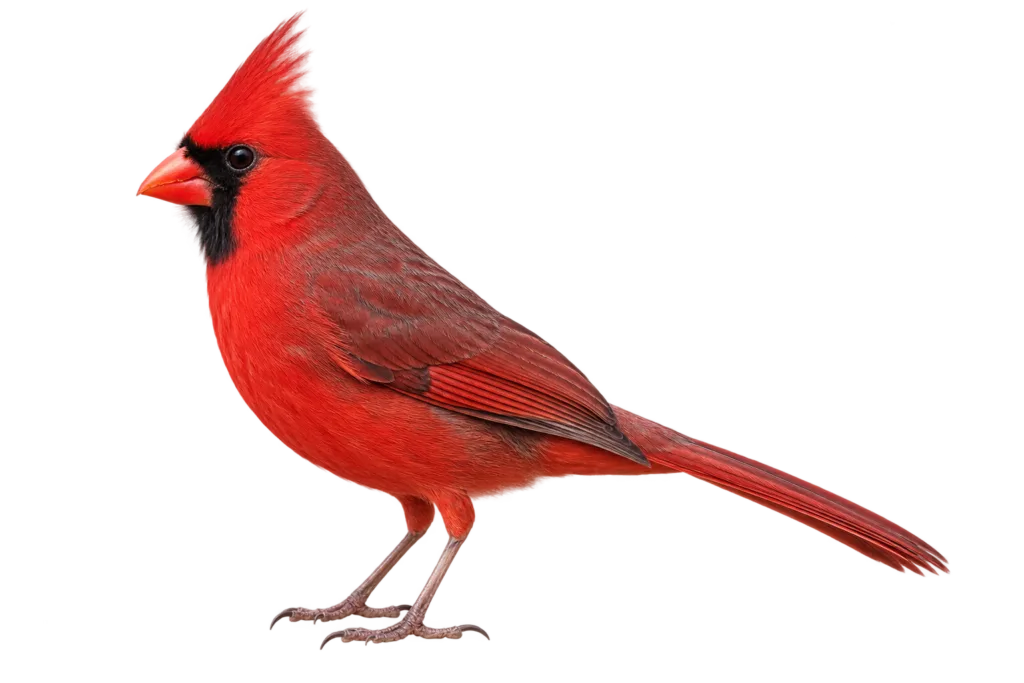
Size at a glance
How big is a Northern Cardinal?
True-scale visual
Northern Cardinal compared with a 175 cm person
When a transparent species asset and body-length data are available, BirdSize places the real bird asset and the fixed human reference on one mathematical centimetre scale.
Compare
Compare Northern Cardinal with another bird
Search by common or scientific name.
Morphology
Detailed measurements
Taxonomy
Classification
The Northern Cardinal (Cardinalis cardinalis) is a medium-sized songbird whose proportions make it look more substantial than many birds of similar mass. Standard references place adults around 21–23 cm (8.3–9.1 in) in length, 42–48 g (1.5–1.7 oz) in weight, and roughly 25–31 cm (9.8–12.2 in) in wingspan. Those numbers describe the general size well, but they do not capture the long tail, heavy bill, adjustable crest, seasonal weight change, or geographic variation found within the species.
Why Northern Cardinals Can Look Larger Than Their Measurements Suggest
A Northern Cardinal has a compact body paired with a relatively long tail. The tail extends well behind the body when the bird is perched, while the raised crest adds height above the head. Together, these features create a larger visual outline without requiring a particularly heavy body.
The bill adds to that impression. It is short but unusually deep and thick for a songbird of this size. Seen from the side, the head can therefore appear broad and solid rather than narrow. The effect is especially noticeable in an alert cardinal with its crest raised.
Published size comparisons commonly place the species between a sparrow and an American Robin, with a Northern Cardinal slightly smaller than the robin. Its shape is quite different, however. A robin has a longer-looking body and more slender bill, while a cardinal concentrates much of its visual weight around the head, chest, and tail.
Body Size Changes Across the Cardinal’s Range
Adult Northern Cardinals should not be treated as though every population has exactly the same dimensions. A field study comparing live cardinals from Florida, Mississippi, Ohio, and New York found a clear geographic pattern in body size.
Birds from the northern populations were generally heavier and had longer wing chords and tarsi than birds from the southern populations. Tail length also varied geographically, although the north-to-south difference was less pronounced than the pattern in mass, wing chord, and tarsus length.
A species-wide length or weight range is useful as a reference, but an individual cardinal may naturally fall toward one end of that range because of where its population occurs. Geographic variation is part of the species rather than evidence that one published measurement must be wrong.
The pattern was found in both sexes. Researchers also noted that subspecies differences may contribute to some regional variation. Northern Cardinals occupy a broad range from Central America into southern Canada, giving populations very different climatic conditions in which to live.
Weight Is More Flexible Than Skeletal Size
Body mass can change even when the cardinal’s structural dimensions remain almost unchanged. This distinction matters when comparing a measured bird with a general species weight range.
One multi-season field study recorded an average body mass of about 41.5 g during the breeding-season sample and 47.2 g in the winter sample. The winter birds carried more fat, while wing chord, tarsus length, tail length, and culmen length did not show the same seasonal change.
The heavier winter measurement therefore did not represent a longer-winged or larger-framed bird. It mainly reflected additional energy reserves. A cardinal’s weight can be a more flexible measurement than features based on bones or feather length.
This also helps explain why weight ranges from different studies may not match perfectly. Season, location, body condition, sex, and the population being sampled can all affect the distribution of recorded masses.
Male and Female Cardinals Are More Similar in Structure Than in Color
The plumage difference between the sexes is striking, but their basic body plans are closely matched. Both have the same characteristic crest, long tail, stout conical bill, rounded body, and fairly short, rounded wings.
Males tend to be somewhat larger in some measurements and datasets, but size alone is a poor way to distinguish the sexes in the field. Geographic and individual variation can be large enough to make a simple rule such as “the bigger bird is the male” unreliable.
The visual difference comes mainly from plumage. Adult males have extensive red coloration and a dark facial mask. Females are mostly warm brown or tan, with red concentrated more strongly in areas such as the wings, tail, and crest. The contrast can make males appear heavier or more solid even when two birds have similar structural dimensions.
The Bill, Wings, and Tail Define the Cardinal’s Proportions
The cardinal’s bill is adapted to handling seeds and has a deep, cone-shaped form. Its short length relative to its depth is an important part of the species’ head profile. The bill is not simply a small pointed projection from the face; it forms a substantial part of the front of the head.
The wings have a rounded shape rather than the long, narrow outline associated with birds built for sustained high-speed travel. Northern Cardinals are year-round residents rather than long-distance migrants. They commonly make short flights between shrubs, trees, feeding areas, and cover.
The tail is proportionally conspicuous. When perched, cardinals often hold it downward, making its length easy to see. In flight, the tail also contributes heavily to the bird’s silhouette. A distant cardinal may therefore look longer than expected from its body mass alone.
The Crest Does Not Have One Fixed Height
Crest measurements require more care than a photograph might suggest because a cardinal can actively change the position of its crest feathers. An alert or agitated bird may hold them high and pointed, while a relaxed bird can lower them until the crest is much less obvious.
There is also real geographic variation in crest structure. Current identification treatments recognize a widespread “Common” group and a more restricted “Long-crested” group along part of western coastal Mexico. Birds in the Long-crested group have longer crest feathers, along with differences in bill structure such as a shallower upper mandible.
For this reason, apparent crest height in an image should not be treated as a simple measure of total body size. Feather position, viewing angle, and regional morphology can all change the outline of the head.
Young Cardinals Have the Same Basic Shape but a Different Bill
Juvenile Northern Cardinals already show the recognizable long tail, crest, and heavy bill that characterize adults. Their coloration is closer to that of an adult female than to the bright red adult male.
The bill provides one of the most useful age-related structural clues. Young birds initially have a dark gray to blackish bill rather than the orange-red bill of mature cardinals. As the bird develops, the adult bill coloration appears while the basic stout, seed-cracking shape remains.
This age difference can change how the head looks in photographs. A dark juvenile bill blends more closely with the face, while the bright adult bill creates a sharper boundary and can make the same general bill structure look more prominent.
Data
Measurement sources
- Data status
- Measured
- Size measurements
- Cornell Lab of Ornithology – All About Birds
- Morphology source
- AVONET — Tobias et al. (2022)
- Morphology dataset
- AVONET v7 — BirdLife taxonomy
- Morphology dataset license
- CC BY 4.0
Full source links, dataset definitions, licensing details and measurement methodology are maintained on the Data Sources & Methodology page.