Bird size profile
Sharp-shinned Hawk
Accipiter striatus
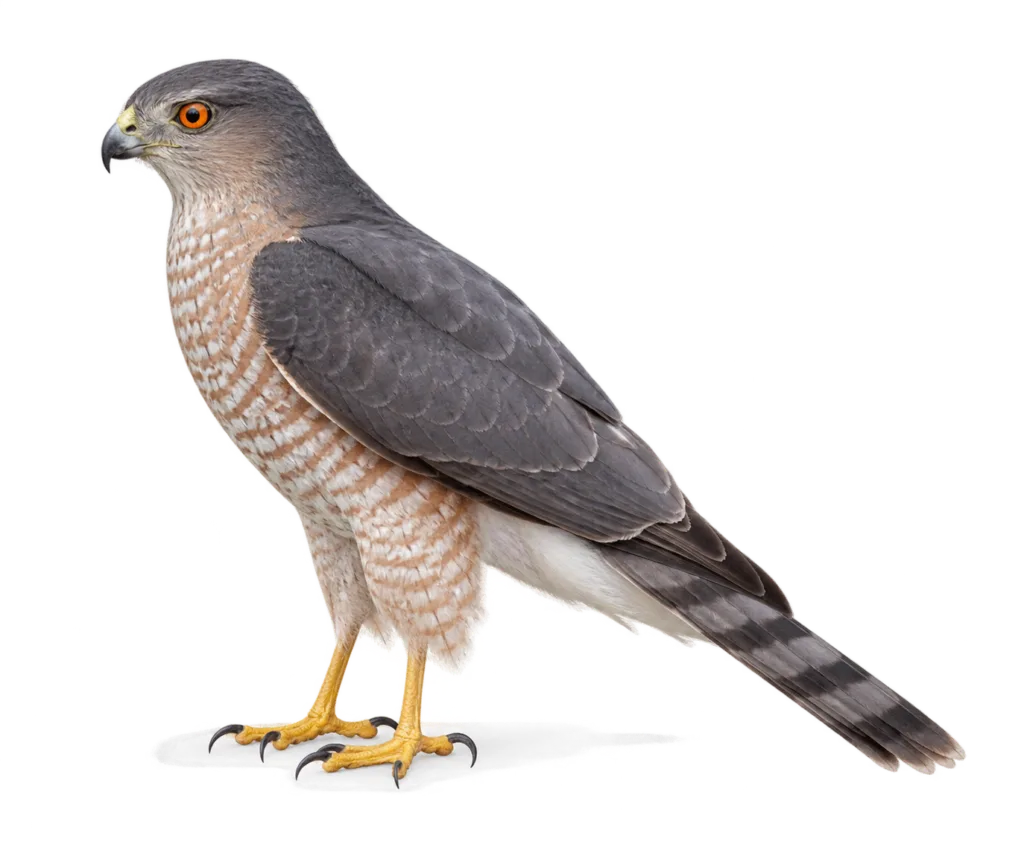
Size at a glance
How big is a Sharp-shinned Hawk?
Compare
Compare Sharp-shinned Hawk with another bird
Search by common or scientific name.
Morphology
Detailed measurements
Taxonomy
Classification
The Sharp-shinned Hawk (Accipiter striatus) is a small forest hawk built around a distinctive set of proportions: a compact body, short rounded wings, a long narrow tail, a small head, and unusually slender lower legs. North American birds span a broad apparent size range because females are much larger than males, making sex one of the main reasons two Sharp-shinned Hawks can look surprisingly different in bulk.
How Large Is a Sharp-shinned Hawk?
Published measurements for North American Sharp-shinned Hawks place overall length at about 24–34 cm (9.4–13.4 in), body mass at roughly 87–218 g (3.1–7.7 oz), and wingspan at about 43–56 cm (16.9–22.1 in). Those ranges should not be read as though every bird varies freely across them. Much of the spread reflects the strong size difference between the sexes.
Males occupy the small end of the species’ size distribution and are among the smallest hawks in Canada and the United States. Females form a distinctly larger size class. A large female can therefore overlap visually with smaller individuals of other forest-hawk species, while a male Sharp-shinned Hawk may look remarkably compact.
Morphometric work on North American Sharp-shinned Hawks has found adult females averaging about 18% longer in wing chord and tail than adult males in the studied samples. The difference in mass was much greater, with the adult female-to-male average close to 1.7 to 1. These are population-level relationships rather than fixed limits for identifying an individual bird.
The Shape Behind the Small Size
A Sharp-shinned Hawk does not simply look like a scaled-down general-purpose hawk. Its body is strongly shaped for maneuvering through wooded habitat. The wings are relatively short and rounded, while the tail extends well behind the body and acts as a steering surface during rapid turns.
The common name refers to this leg structure. The exposed lower leg is not a true anatomical “shin”; the feature involved is the slender, laterally compressed tarsometatarsus. Its narrow profile gives the front of the lower leg the sharp-edged appearance that inspired the English name.
Why Body Length Can Be Misleading
Total length is useful, but it does not describe how that length is distributed. A relatively large share of a Sharp-shinned Hawk’s outline comes from its tail. A bird with a 30 cm total length is therefore not built like a stocky 30 cm bird with a shorter tail.
This is why proportions often give a better impression of the species than a single length figure. The body itself looks compact, the head is small, and the narrow tail projects well beyond the folded wings when the bird is perched. In flight, the same geometry creates the familiar combination of a short front end and a long trailing tail.
Body mass also needs separate interpretation. Weight responds more readily than skeletal or feather measurements to sex, condition, season, and the individual bird. Two Sharp-shinned Hawks with fairly similar linear dimensions can therefore differ more in mass than their length alone would suggest.
What Its Proportions Look Like in Flight
The small head is especially useful when the bird is seen overhead. It often appears tucked close to the wings rather than extending prominently in front of them. The wrists can look slightly pushed forward, while the rounded wings produce fast, shallow wingbeats.
Direct flight commonly alternates several quick beats with a short glide. The long tail remains an important part of the silhouette throughout this cycle. During turns, it may spread and change apparent shape, so a tail that looks square in one view can look somewhat rounded in another. Feather wear, molt, viewing angle, and whether the tail is spread can all change the outline.
Leg thinness or tail-tip shape should not carry an identification by itself. A stronger assessment combines head projection, overall proportions, wing shape, tail length, flight style, plumage, and the quality of the view.
Male and Female Size Overlap Changes Field Appearance
The strong female-biased size difference creates an unusually wide range of appearances within one species. A small male can look delicate and almost falcon-like at a distance, while a female has a deeper body and more substantial overall presence. The underlying Sharp-shinned proportions remain similar, but scale changes how obvious individual features appear.
This also explains why size alone is unreliable when a bird is seen without a familiar object for scale. A female Sharp-shinned Hawk may approach the size of a small male Cooper’s Hawk, even though the species differ in several structural details. For a Sharp-shinned Hawk profile, the important point is that female size sits well above male size within the species itself.
Measurement Ranges Depend on Which Population Is Being Described
Accipiter striatus has a broad geographic distribution and includes regional populations that differ in plumage and morphology. Measurements published for the familiar migratory birds of Canada and the United States should not automatically be treated as exact limits for every tropical or island population historically included in the Sharp-shinned Hawk complex.
Taxonomy is also still relevant to how older measurement tables are interpreted. A proposal considered by the American Ornithological Society in 2024 would have separated mainland birds from Caribbean populations, but that proposal did not pass. Under the current North American treatment, the Sharp-shinned Hawk remains Accipiter striatus. A later genus revision adopted in 2025 also retained this species in Accipiter, even as several superficially similar hawks were moved to other genera.
For practical size interpretation, the safest approach is to match measurements to the population, sex, age class, and measurement method whenever those details are available. The broad species-level range is useful for scale, but the Sharp-shinned Hawk’s most informative physical feature is the combination of small body size, strong female-biased size dimorphism, short rounded wings, a long tail, and very slender legs.
Data
Measurement sources
- Data status
- Measured
- Size measurements
- AVONET — Tobias et al. (2022)
- Morphology source
- AVONET — Tobias et al. (2022)
- Morphology dataset
- AVONET v7 — BirdLife taxonomy
- Morphology dataset license
- CC BY 4.0
Full source links, dataset definitions, licensing details and measurement methodology are maintained on the Data Sources & Methodology page.