Bird size profile
Blue Jay
Cyanocitta cristata
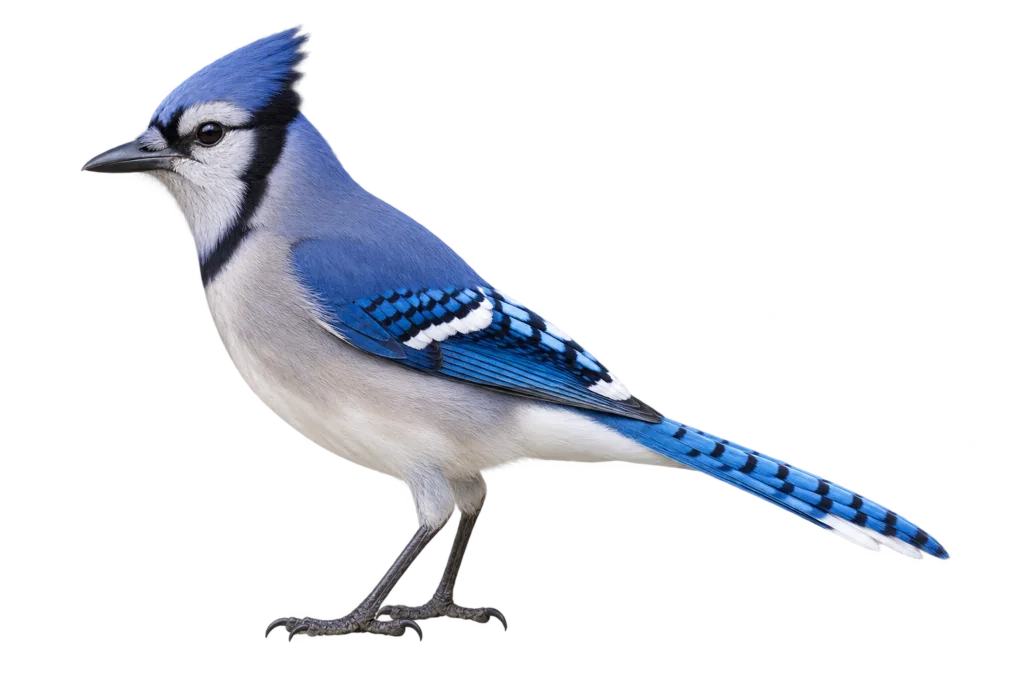
Size at a glance
How big is a Blue Jay?
True-scale visual
Blue Jay compared with a 175 cm person
When a transparent species asset and body-length data are available, BirdSize places the real bird asset and the fixed human reference on one mathematical centimetre scale.
Compare
Compare Blue Jay with another bird
Search by common or scientific name.
Morphology
Detailed measurements
Taxonomy
Classification
The Blue Jay (Cyanocitta cristata) is a large, crested songbird with a body plan that can make it appear heavier than it is. Most adult measurements fall around 25–30 cm (9.8–11.8 in) in length, 70–100 g (2.5–3.5 oz) in weight, and 34–43 cm (13.4–16.9 in) in wingspan. Its long tail, broad shape, strong bill, and adjustable crest all affect how its size is perceived in the field.
How Large Is a Blue Jay?
A Blue Jay occupies an unusual size range among familiar backyard birds. It is generally larger in appearance than a robin, yet far smaller and lighter than an American Crow. Length alone does not fully explain that impression because much of the jay’s outline comes from its head, crest, wings, and long tail rather than a particularly heavy body.
- Length: 25–30 cm (9.8–11.8 in)
- Weight: 70–100 g (2.5–3.5 oz)
- Wingspan: 34–43 cm (13.4–16.9 in)
Published values are not identical in every reference. Some broader biological datasets extend total length to about 22 cm at the lower end and body mass to roughly 65–109 g. These differences can reflect the birds sampled, geographic variation, age, condition, and measurement methods. They should not be combined into a newly calculated average.
For normal field comparison, the 25–30 cm length and 70–100 g weight ranges give a useful picture of a typical adult Blue Jay.
Much of Its Length Comes From the Tail
Total bird length is measured from the tip of the bill to the end of the tail. In a Blue Jay, the broad, fairly long tail contributes a noticeable share of that measurement. This helps explain why a jay can approach the total length of some much heavier-looking birds without having the same body mass.
The rest of the silhouette is equally distinctive. Blue Jays have a large head, a strong straight bill, rounded wings, and a prominent crest. The body itself is sturdy rather than especially elongated. With the tail folded behind the bird, a perched jay can therefore look compact through the chest while still measuring close to 30 cm from bill to tail tip.
The crest changes the visible outline but is not part of the standard bill-to-tail measurement. A fully raised crest makes the head look taller and can give the impression of a larger bird. With the crest flattened, the same individual has a much sleeker profile.
Wingspan Is Not the Same as Wing Length
The commonly published 34–43 cm (13.4–16.9 in) wingspan describes the distance from one wingtip to the other when both wings are extended. Ornithological datasets may also provide a much smaller value called wing length or wing chord.
Morphological data compiled for Blue Jays place measured wing length at roughly 118–142 mm in the available sample. This measurement runs along one folded or prepared wing from the carpal region toward the longest primary feather. It does not represent the bird’s full tip-to-tip span.
A 130 mm wing measurement does not imply a 260 mm wingspan. Full wingspan also includes the opposite wing, the width of the body, and the way the wings extend from the shoulders. Wing chord and wingspan should therefore be kept as separate measurements rather than converted from one another.
Male and Female Blue Jays Overlap in Size
Male and female Blue Jays look very similar, and their measurement ranges overlap heavily. Males are described as slightly larger on average, but the difference is too small to make body size a dependable way to identify sex in a free-living bird.
A large female can fall within the same length and weight range as a male, while a smaller male can overlap females. Plumage also offers little help because both sexes share the familiar blue upperparts, pale underparts, black facial and throat markings, white wing pattern, and crest.
This is an important distinction when interpreting measurements. A Blue Jay near the upper end of the normal range should not automatically be treated as male, nor should a lighter individual automatically be considered female.
Blue Jay Size Compared With Familiar Birds
| Bird | Length | Weight | Wingspan |
|---|---|---|---|
| Blue Jay | 25–30 cm | 70–100 g | 34–43 cm |
| American Robin | 20–28 cm | 77–85 g | 31–40 cm |
| Eastern Bluebird | 16–21 cm | 28–32 g | 25–32 cm |
| Steller’s Jay | 30–34 cm | 100–140 g | about 44 cm |
| American Crow | 40–53 cm | 316–620 g | 85–100 cm |
The American Robin is a useful example of why length and body bulk should be considered separately. The upper end of its length range overlaps a Blue Jay, and typical robin body mass also overlaps the jay’s lower range. Even so, a Blue Jay usually looks larger because of its broader head, crest, stronger bill, and different tail proportions.
An Eastern Bluebird is much smaller. Despite the shared blue coloration, it has less than half the body mass of many Blue Jays and a noticeably shorter maximum wingspan.
Steller’s Jay, the other North American member of Cyanocitta, is generally larger. Adults commonly reach 30–34 cm and 100–140 g. The American Crow is in another size class altogether: even a light adult crow weighs several times as much as a typical Blue Jay, while its wingspan is roughly twice as broad.
Shape Can Be More Useful Than an Estimated Size
Distance can make field estimates unreliable, especially when a bird is seen alone without a nearby object for scale. A Blue Jay perched high in a tree may look crow-sized, while the same bird beside a larger corvid immediately appears much smaller.
Its proportions remain more consistent. Look for a large head, prominent crest, stout straight bill, broad rounded tail, and rounded wings. The tail is especially useful in flight, where it extends well behind the body and helps create the Blue Jay’s long silhouette.
Posture also changes the apparent dimensions. Raised feathers increase visible bulk without changing actual body size, while a lowered crest and tightly held plumage make the bird look narrower. A perched bird with its tail angled toward the observer can appear surprisingly short; viewed from the side, the same tail reveals much more of its full length.
These proportions explain why a Blue Jay is best described as a large songbird rather than a small crow. Its measurements place it between many common thrush-sized birds and the much heavier crow family members that dominate the upper end of the familiar backyard size range.
Data
Measurement sources
- Data status
- Measured
- Size measurements
- Cornell Lab of Ornithology – All About Birds
- Morphology source
- AVONET — Tobias et al. (2022)
- Morphology dataset
- AVONET v7 — BirdLife taxonomy
- Morphology dataset license
- CC BY 4.0
Full source links, dataset definitions, licensing details and measurement methodology are maintained on the Data Sources & Methodology page.