Bird size profile
Great Blue Heron
Ardea herodias
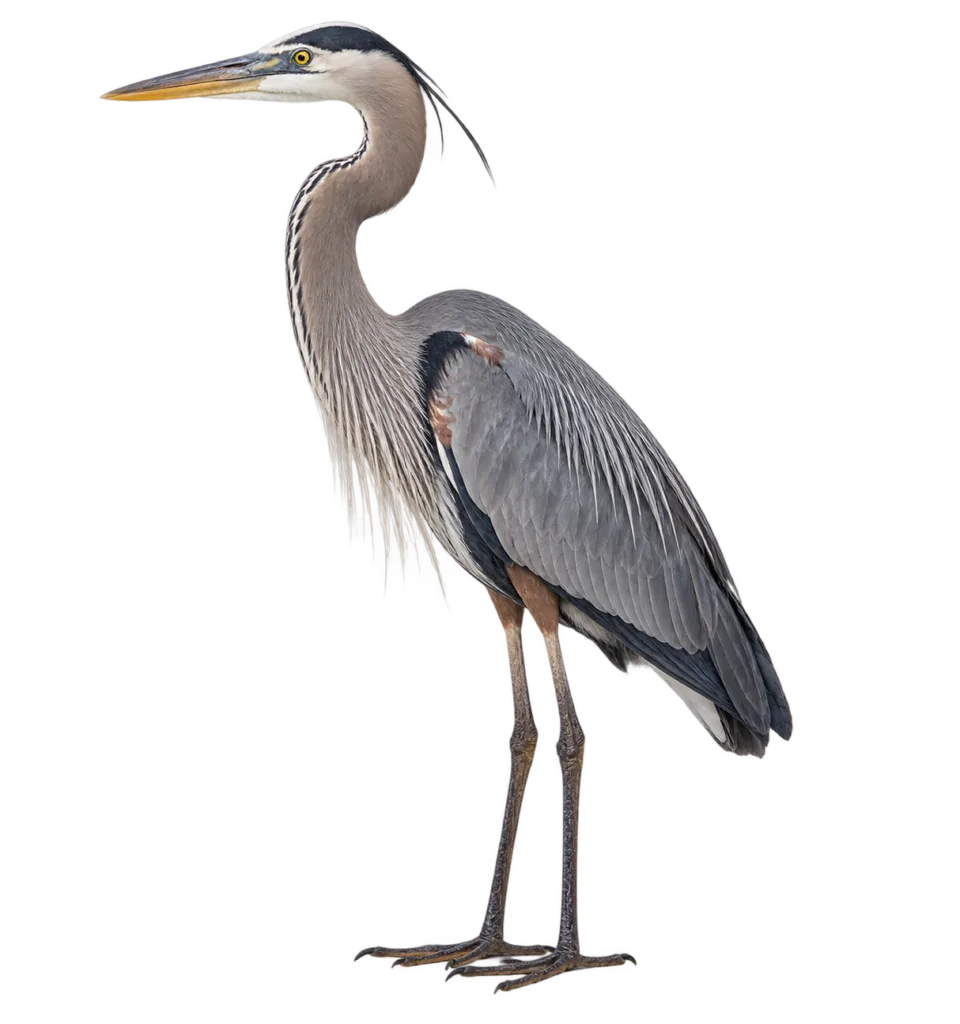
Size at a glance
How big is a Great Blue Heron?
True-scale visual
Great Blue Heron compared with a 175 cm person
When a transparent species asset and body-length data are available, BirdSize places the real bird asset and the fixed human reference on one mathematical centimetre scale.
Compare
Compare Great Blue Heron with another bird
Search by common or scientific name.
Morphology
Detailed measurements
Taxonomy
Classification
The Great Blue Heron (Ardea herodias) is the largest heron in North America, but its size is built more from length than bulk. Long legs, an unusually long neck, a spear-shaped bill, and broad wings create a bird that can look almost human-height when fully upright even though its body mass is only a few kilograms.
Its Size Comes From Length, Not Bulk
Published measurements place adult Great Blue Herons at about 97–137 cm (38.2–53.9 in) in length, with a mass of roughly 2.1–2.5 kg (4.6–5.5 lb). That combination explains much of the bird’s appearance: it is exceptionally long for its weight.
The torso itself is not especially massive. Much of the visible scale comes from the legs and neck extending well beyond the compact central body. A Great Blue Heron can reach about 4.5 feet tall when standing upright, yet standing height should not be confused with the standard length figures used in bird measurements. Posture changes the vertical height of a heron far more than it would for a compact-bodied bird.
Length and Standing Height Describe Different Things
A heron’s published body length and the height it reaches above the ground are not interchangeable measurements. The neck can be folded, partly extended, or stretched nearly straight, so the same individual may present very different apparent heights without any change in body size.
The Neck Changes the Bird’s Apparent Size
The Great Blue Heron’s neck is long enough to transform its silhouette. During quiet standing and walking, it is commonly held in a curved or partly folded position. When the bird focuses on prey, the neck can extend forward and then straighten rapidly during a strike.
This flexibility makes photographs a poor basis for judging height unless posture is taken into account. A relaxed bird with its head drawn back can appear much shorter than another Great Blue Heron standing with the neck raised. The difference is especially noticeable when comparing the bird with a person, fence, shoreline object, or another wading species.
Neck posture also changes in flight. Rather than flying with the head and neck fully extended, a Great Blue Heron normally pulls the neck back into a tight S-shaped curve. This shortens the front of the flying silhouette while the long legs project beyond the tail.
A Wingspan That Can Reach About Two Meters
The wings span approximately 167–201 cm (65.8–79.1 in). At the upper end of that range, the distance from wingtip to wingtip is just over two meters.
The wings are broad and rounded rather than narrow and pointed. Their shape helps produce the slow, deep wingbeats associated with large herons. In flight, the combination of broad wings, a retracted neck, and trailing legs creates proportions that are very different from the bird’s tall standing profile.
This distinction matters when interpreting size. The full wingspan is much greater than the width of a standing bird with folded wings, while the extended legs make the flying silhouette look longer behind the body. Neither dimension should be substituted for ordinary body length.
How It Compares With Other Large Wading Birds
The Great Blue Heron’s scale becomes clearer when length and mass are considered together. Several large wading birds may look similar in height from a distance, yet their body bulk can differ sharply.
| Species | Length | Mass | Wingspan |
|---|---|---|---|
| Great Blue Heron | 97–137 cm | 2.1–2.5 kg | 167–201 cm |
| Great Egret | 94–104 cm | About 1.0 kg | 131–145 cm |
| Sandhill Crane | About 120 cm | 3.4–4.9 kg | — |
A Great Egret can approach the lower end of Great Blue Heron length measurements, but it is much lighter and has a shorter wingspan. The difference is often obvious when the two species stand near each other: the Great Blue Heron has a larger frame, heavier bill, and broader overall structure.
The Sandhill Crane shows why length alone does not describe bulk. Its published body length falls within the broad Great Blue Heron range, yet its mass can be far greater. A crane therefore looks thicker and heavier even when the two birds appear comparable in height.
Long Legs Add Height Without Adding Much Body Bulk
The legs account for a large share of the Great Blue Heron’s standing height. They elevate the body well above the ground and allow the bird to move through shallow water while keeping most of its plumage clear of the surface.
Because the body is carried high, a standing Great Blue Heron can appear larger than its weight suggests. The effect becomes stronger when the neck is extended. With the neck folded lower, the legs remain long and obvious, but the bird’s total vertical profile drops considerably.
The feet also contribute to the elongated outline. Long toes spread the bird’s support across soft mud, vegetation, and uneven wetland surfaces. They are easy to overlook in distant views, yet they extend the leg structure well below the ankle joint that is often mistaken for the knee.
The Bill Extends the Head Well Beyond the Neck
The Great Blue Heron has a thick, straight, daggerlike bill. Its length reinforces the bird’s stretched proportions, especially when the neck is extended horizontally while hunting.
A side profile therefore contains several long elements arranged in sequence: bill, head, neck, body, legs, and toes. That structure is one reason the species can occupy so much visual space without having the mass expected from a similarly tall mammal.
The same anatomy can also make body-length estimates from casual photographs unreliable. A forward-pointing bill and extended neck increase the visible head-to-tail dimension, while a tightly folded neck produces a much more compact outline.
Not Every Adult Has Exactly the Same Proportions
Adult males and females look much alike, but males tend to be larger. This size overlap means that an individual cannot normally be sexed in the field from overall dimensions alone.
Geographic variation adds another layer. Research using museum specimens has found differences in measurements such as bill depth, exposed bill length, tarsus length, and middle-toe length among some Great Blue Heron populations. Birds from Florida also include blue, white, and intermediate-looking forms, and their proportions are not identical across every population.
For that reason, the broad published size range is more useful than treating one number as the exact dimensions of every Great Blue Heron. A neutral standing bird with folded wings gives the clearest representation of ordinary scale, while an extended neck, crouched hunting pose, takeoff posture, or fully spread wings can make the same species appear markedly different in size.
Data
Measurement sources
- Data status
- Measured
- Size measurements
- Cornell Lab of Ornithology – All About Birds
- Morphology source
- AVONET — Tobias et al. (2022)
- Morphology dataset
- AVONET v7 — BirdLife taxonomy
- Morphology dataset license
- CC BY 4.0
Full source links, dataset definitions, licensing details and measurement methodology are maintained on the Data Sources & Methodology page.