Bird size profile
Great Horned Owl
Bubo virginianus
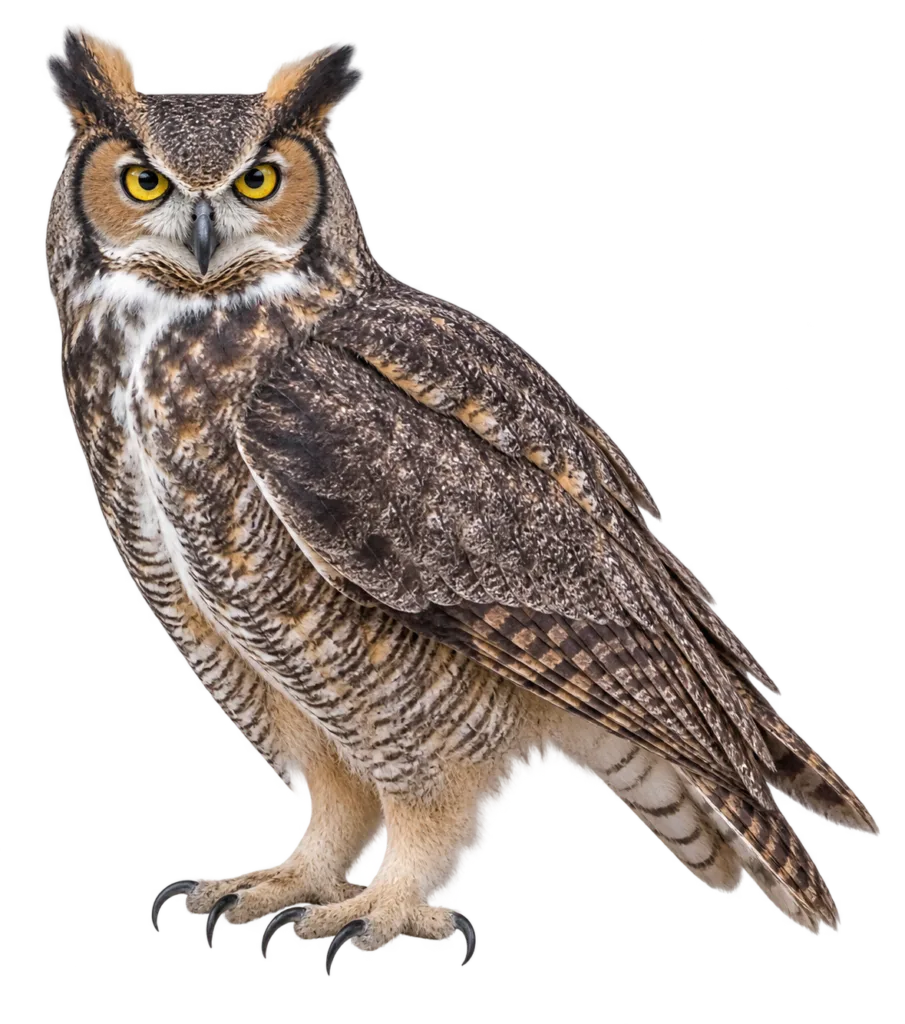
Size at a glance
How big is a Great Horned Owl?
True-scale visual
Great Horned Owl compared with a 175 cm person
When a transparent species asset and body-length data are available, BirdSize places the real bird asset and the fixed human reference on one mathematical centimetre scale.
Compare
Compare Great Horned Owl with another bird
Search by common or scientific name.
Morphology
Detailed measurements
Taxonomy
Classification
The Great Horned Owl (Bubo virginianus) has the heavy, compact build expected of one of the larger owls of the Americas. Adults are broad through the body, large-headed, and carried on powerful feet, while their rounded wings add considerable width in flight. Published measurements commonly place adults at about 46–63 cm (18.1–24.8 in) in length, 910–2,500 g (32.1–88.2 oz) in weight, and 101–145 cm (39.8–57.1 in) across the wings. Those wide ranges reflect more than ordinary individual variation: sex and geographic origin both affect how large a Great Horned Owl can be.
A Heavy Build Matters More Than Height
A perched Great Horned Owl can look exceptionally large because much of its visible shape is concentrated into a thick body and broad head. Its neck is not strongly exposed, the bill is short, and dense plumage smooths the transition between the head and torso. The result is a compact silhouette rather than the long, narrow outline seen in some other large birds.
The wings follow the same pattern. They are broad and rounded rather than long and sharply pointed. When folded, they reinforce the owl’s thick-bodied appearance. When spread, they create a much larger visual footprint, with the longest documented wingspans approaching 1.45 meters in commonly used North American measurement references.
The “horns” do not add to the owl’s structural size
The two prominent projections above the head are feather tufts, not ears or horn-like parts of the skull. Their position can make an alert owl appear taller, but the tufts can also be lowered until they are much less obvious. Body length measurements do not treat the raised tufts as extra height.
Females Are Larger Than Males
Great Horned Owls show reverse sexual size dimorphism: females are larger and heavier than males. Average figures reported for studied birds place females near 1.7 kg and males near 1.3 kg, although the full species-wide weight range is much broader.
This difference is useful when interpreting an owl seen in the field. Two adults from the same area can have clearly different body mass and bulk without belonging to different forms or age classes. Size alone, however, is not a reliable way to determine sex because large males and small females can overlap.
The sex difference is not limited to one isolated population. A morphometric study of 418 Great Horned Owl specimens found that reverse size dimorphism remained remarkably consistent among the regions examined, even though the average body size of the owls themselves changed geographically.
Geographic Variation Creates More Than One Typical Size
The Great Horned Owl occupies an enormous geographic range, and birds from different parts of that range do not share one uniform body size. Museum measurements have documented variation across both geographic regions and traditionally recognized subspecies.
A detailed North American study found the largest regional averages among specimens from Ontario, while specimens from Texas and California were among the smallest in the regions examined. The pattern was more complicated than a simple rule in which every northern population was larger than every southern population.
This is important because some general descriptions state that Great Horned Owls become progressively larger toward northern latitudes. There is a broad geographic component to size, but direct specimen analysis found only limited support for such a simple north-to-south rule. Regional and subspecific differences do not form a perfectly ordered latitude gradient.
Body proportions also vary. The same research found more geographic variation in measurements associated with the central body than in skull, leg, and wing characters. In other words, two Great Horned Owls can differ noticeably in mass and body bulk while retaining the recognizable proportions that identify the species.
Feathers Make the Owl Look Bigger Than Its Body
Visible size and anatomical size are not identical in an owl. Great Horned Owls have dense, soft plumage that adds considerable apparent volume around the torso, head, and legs. A perched bird therefore looks wider and fuller than the underlying skeleton and muscle mass alone would suggest.
The rounded facial region adds to this effect. Forward-facing eyes sit within a broad facial disc, while feathers partially conceal the short bill. Because less of the bill projects beyond the face than in many hawks, the head can appear almost circular from some angles.
The feather-covered legs end in large feet equipped with long, curved talons. Much of the upper leg is normally hidden beneath body feathers, so the apparent transition from body to foot can be abrupt. This contributes to the impression of a bulky bird resting on relatively short visible legs.
Posture changes the outline further. An alert owl can stretch upward and raise its ear tufts, while a relaxed or cold bird may fluff its feathers into a broader shape. Photographs of different postures can therefore make adults of similar structural size look surprisingly different.
Great Horned Owl Size Compared With Other Large Owls
Height alone can give the wrong impression when large owl species are compared. The Great Gray Owl, for example, can be substantially longer from head to tail than a Great Horned Owl but often weighs less. Its exceptional apparent size comes partly from long dimensions and extensive plumage rather than a heavier body.
| Species | Adult Length | Weight | Wingspan | Build |
|---|---|---|---|---|
| Great Horned Owl | 46–63 cm | 910–2,500 g | 101–145 cm | Heavy and compact |
| Great Gray Owl | 61–84 cm | 700–1,700 g | 137–153 cm | Tall, broad-feathered, relatively light |
| Snowy Owl | 52–71 cm | 1,600–2,950 g | 126–145 cm | Large and particularly heavy |
The comparison shows why labels such as “largest owl” need a defined measurement. A Great Gray Owl can exceed a Great Horned Owl in length and wingspan, while a Snowy Owl can exceed it in body mass. The Great Horned Owl combines moderate-to-large linear dimensions with a notably dense, powerful body.
Young Owls Approach Adult Mass Before They Look Fully Adult
Great Horned Owl chicks begin life extremely small compared with their parents. Recorded nestlings have averaged only about 35 g shortly after hatching, followed by rapid weight gain during their first weeks.
Development differs between the sexes early enough to become measurable. In one monitored sample, young females reached about 1,000 g at roughly 25 days, while young males reached about 800 g around 29 days. Growth slows as fledging approaches.
Young Great Horned Owls can leave the nest before reaching full adult mass. Monitored juveniles that first left the nest at roughly six to seven weeks were around three-quarters of expected adult mass. Their proportions and plumage were still changing, so a recently fledged owl should not be judged against adult measurements simply from its apparent height or feather volume.
Juveniles also carry conspicuous fluffy plumage, particularly around the head. This can hide their developing proportions and make them look rounder than adults. As juvenile feathering is replaced and the body matures, the familiar broad-headed, thick-bodied adult outline becomes much clearer.
The Most Reliable Size Impression Comes From Proportion
For identification, the Great Horned Owl’s combination of traits is more useful than any single measurement. The bird has a large head, thick torso, short visible bill, broad rounded wings, prominent feather tufts, and powerful feet. These features remain recognizable despite substantial variation in body mass, sex, regional origin, and posture.
A distant owl that appears unusually tall is not necessarily heavier, and a heavily feathered bird is not necessarily structurally larger. Length, mass, wingspan, feather volume, and posture describe different aspects of size. Keeping those measurements separate gives a much more accurate picture of how large a Great Horned Owl actually is.
Data
Measurement sources
- Data status
- Measured
- Size measurements
- Cornell Lab of Ornithology – All About Birds
- Morphology source
- AVONET — Tobias et al. (2022)
- Morphology dataset
- AVONET v7 — BirdLife taxonomy
- Morphology dataset license
- CC BY 4.0
Full source links, dataset definitions, licensing details and measurement methodology are maintained on the Data Sources & Methodology page.