Bird size profile
Snowy Owl
Bubo scandiacus
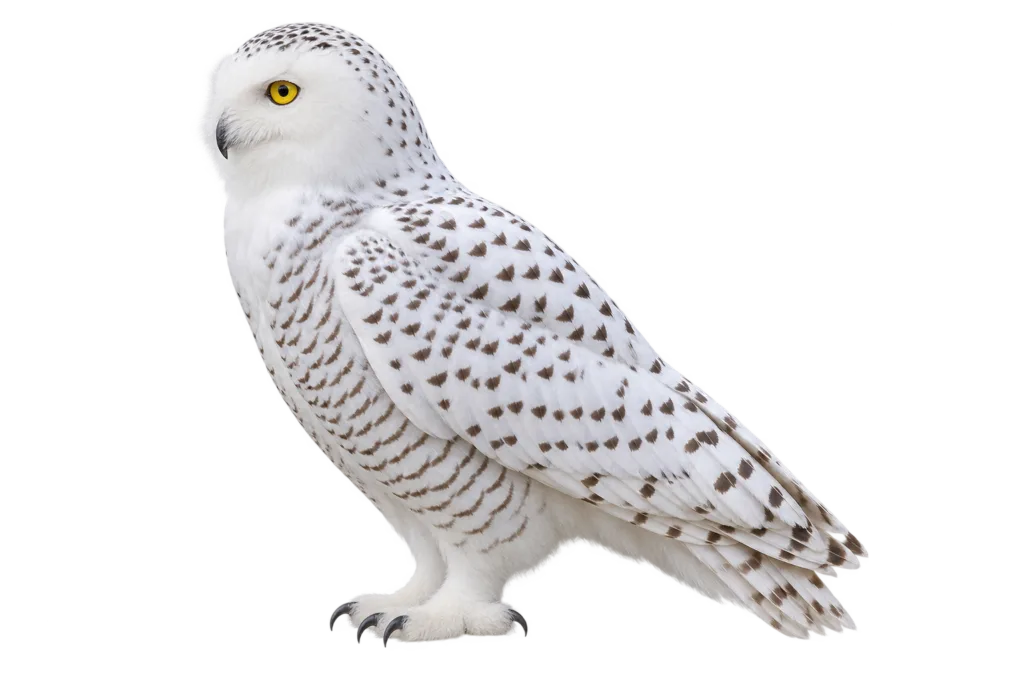
Size at a glance
How big is a Snowy Owl?
True-scale visual
Snowy Owl compared with a 175 cm person
When a transparent species asset and body-length data are available, BirdSize places the real bird asset and the fixed human reference on one mathematical centimetre scale.
Compare
Compare Snowy Owl with another bird
Search by common or scientific name.
Morphology
Detailed measurements
Taxonomy
Classification
The Snowy Owl (Bubo scandiacus) combines a large frame with unusually dense feathering, so its visible bulk does not come from skeletal size alone. It is close to the Great Horned Owl in general dimensions, yet its body mass can be higher, while the longer Great Gray Owl can weigh much less. Those contrasts make length, wingspan, and weight useful for different parts of understanding Snowy Owl size.
A Heavy Owl, Not Simply a Tall One
Published measurements place Snowy Owls at about 52–71 cm (20.5–27.9 in) in body length, with a wingspan of roughly 126–145 cm (49.6–57.1 in). Recorded body mass spans approximately 1,600–2,950 g (56.4–104.1 oz). These figures describe a large owl, but mass is the measurement that most clearly separates it from many other northern owls.
A bird near the upper end of the weight range can approach 3 kg even though some other owl species exceed it in total body length. This is why descriptions based only on height or length can give a misleading impression of relative size.
A longer owl is not automatically a heavier owl. Body proportions, muscle, feather volume, tail length, and other structural differences all affect how two species compare.
Female Size Changes the Upper End of the Range
Snowy Owls show female-biased size dimorphism. Females are generally larger than males, a pattern found in many birds of prey. The difference is especially useful when interpreting broad species-level measurement ranges because the smallest and largest adults should not be treated as examples of one uniform body size.
Sexes can still overlap. A measurement by itself therefore does not provide a reliable sex identification for every individual. Size works better when considered with plumage, age, and several physical features together.
The larger build of females also helps explain why photographs of two adult Snowy Owls can show a noticeable difference in body volume even when both birds have the same basic rounded silhouette.
Dense Feathering Adds to the Snowy Owl Silhouette
The Snowy Owl’s Arctic appearance is strongly shaped by its plumage. Thick insulating feathers cover the body, and feathering extends down the legs and over much of the feet. When the bird is sitting, this can create a broad lower body with little visible separation between the torso and legs.
The head is smoothly rounded and normally lacks obvious projecting ear tufts. Combined with the compact facial outline and heavily feathered body, this produces a shape that can look almost continuous from head to feet when the feathers are relaxed.
Plumage Can Change How Large a Bird Appears
Body markings do not change the physical dimensions of a Snowy Owl, but they can affect visual estimates of size. Adult males tend to become whiter with age, and some older males are almost entirely white. Females usually retain more dark barring, while young birds can also be strongly marked.
Heavy barring creates more visible edges across the body and wings. A nearly white bird against a pale background can show less obvious separation between body parts. As a result, two similarly sized individuals may give different impressions of width or proportion when viewed at a distance.
Plumage is also why an almost completely white bird should not automatically be treated as representative of every adult Snowy Owl. The species includes birds ranging from nearly unmarked white to individuals with extensive dark bars across much of the body.
How Snowy Owl Size Compares with Other Large Owls
The distinction between length and mass becomes clearer when the Snowy Owl is placed beside two familiar large North American owls. The measurements below use the same reference system so the ranges can be compared without mixing unrelated datasets.
| Species | Length | Weight | Wingspan |
|---|---|---|---|
| Snowy Owl | 52–71 cm | 1,600–2,950 g | 126–145 cm |
| Great Horned Owl | 46–63 cm | 910–2,500 g | 101–145 cm |
| Great Gray Owl | 61–84 cm | 700–1,700 g | 137–153 cm |
The Great Gray Owl reaches a greater body length and a somewhat broader maximum wingspan, yet its published weight range is much lower. Much of its imposing outline comes from feathers and long proportions rather than exceptionally high body mass.
The Great Horned Owl is a closer match to the Snowy Owl in general scale. Their maximum published wingspans in this dataset are the same, but the Snowy Owl extends farther at the upper end of both length and body mass. Calling one species simply “larger” without naming the measurement therefore loses useful information.
Broad Wings Add a Different Kind of Scale in Flight
A perched Snowy Owl emphasizes body mass and dense feathering. In flight, the wings become the dominant dimension. A span reaching roughly 1.45 m creates a much wider profile than the compact resting bird suggests.
The wings are broad rather than narrow and sharply pointed. This matters when estimating size because a distant flying Snowy Owl can appear much larger than the same bird seen sitting on open ground. Perspective adds another source of error: without a nearby object of known size, wingspan is particularly difficult to judge accurately.
Body length should not be confused with standing height either. Standard bird length is normally measured from the tip of the bill to the end of the tail on a prepared or properly positioned bird. It is not the same measurement as the vertical distance from the ground to the top of the head.
Why Published Snowy Owl Measurements Can Differ
Snowy Owl dimensions do not always appear as identical numbers in reference works. Some datasets combine both sexes across broad geographic samples, while others report averages, narrower samples, or sex-specific values. Older sources may also use different measurement conventions.
For that reason, a length range from one source should not be combined with a maximum wingspan or weight from another source to create a new synthetic range. Each published set is most useful when its measurements remain together.
The broad biological pattern is more stable than any single endpoint: Snowy Owls are large, heavy-bodied owls; females tend to be larger than males; dense feathering increases their visible bulk; and their weight is unusually high relative to several other long-bodied northern owl species.
Estimating Size from a Wild Snowy Owl
Open terrain often provides a useful view of the entire bird, but visual estimates still depend heavily on posture. A resting owl may compress its neck and body feathers, while another individual can appear taller after stretching or becoming alert. Wind can also alter the feather outline.
- Use nearby objects only when their dimensions are reasonably known.
- Do not estimate sex from apparent size alone because male and female measurements overlap.
- Judge body shape separately from feather volume.
- In flight, compare wing width and span rather than relying on the apparent size of the body.
- When plumage is visible, combine pattern, age-related appearance, and size instead of treating any one feature as decisive.
A Snowy Owl sitting low on the ground can hide much of its true vertical dimension, while its feathered legs make the base of the body look unusually wide. Once it takes flight, the same individual presents a span that may be more than twice its measured body length.
Data
Measurement sources
- Data status
- Measured
- Size measurements
- Cornell Lab of Ornithology – All About Birds
- Morphology source
- AVONET — Tobias et al. (2022)
- Morphology dataset
- AVONET v7 — BirdLife taxonomy
- Morphology dataset license
- CC BY 4.0
Full source links, dataset definitions, licensing details and measurement methodology are maintained on the Data Sources & Methodology page.