Bird size profile
Osprey
Pandion haliaetus
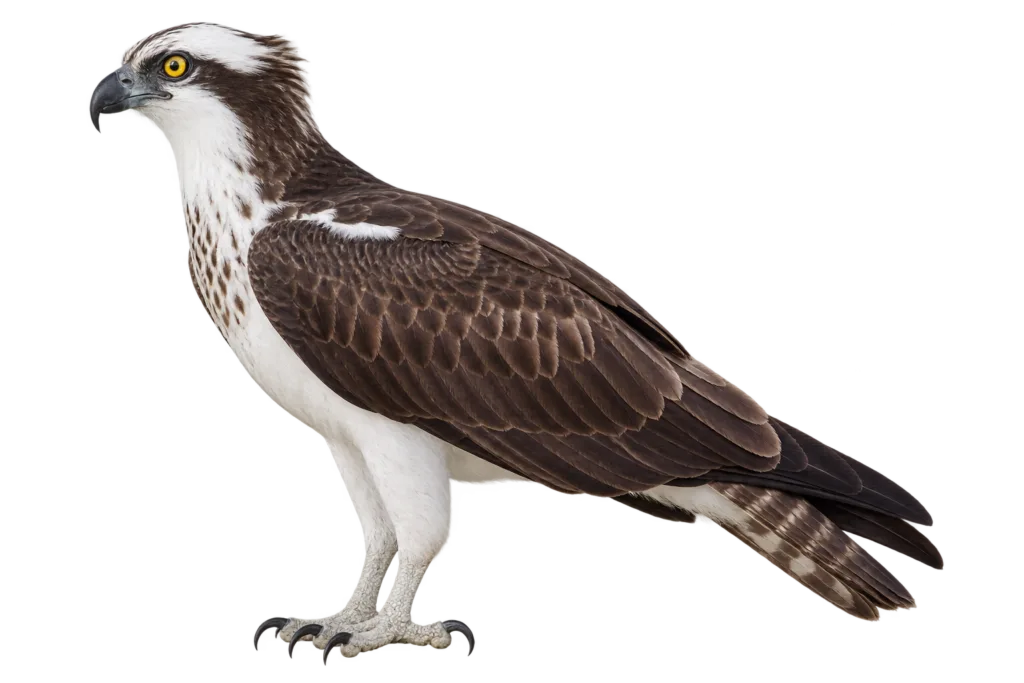
Size at a glance
How big is an Osprey?
True-scale visual
Osprey compared with a 175 cm person
When a transparent species asset and body-length data are available, BirdSize places the real bird asset and the fixed human reference on one mathematical centimetre scale.
Compare
Compare Osprey with another bird
Search by common or scientific name.
Morphology
Detailed measurements
Taxonomy
Classification
The Osprey (Pandion haliaetus) is a large raptor whose size is expressed more through its wings than through a heavy body. An adult has a relatively slender torso, long legs and long, narrow wings that create a broad flight silhouette. Published measurements commonly place adults at roughly 52–60 cm (20.5–23.6 in) in body length, with wingspans extending from about 145 to 180 cm (4 ft 9 in to 5 ft 11 in). Adult mass is generally around 1.2–2.0 kg (2.6–4.4 lb), although population and sex affect the figures reported in individual datasets.
Long Wings Dominate the Osprey’s Proportions
An Osprey can look much larger in the air than it does on a perch. The reason is its combination of a moderate body length and a wingspan that can approach three times that length. The wings are relatively long and narrow for such a large bird of prey, rather than broad and massive like those of many large eagles.
The shape becomes especially clear from below. Ospreys usually hold the wings with a noticeable bend at the wrist, producing the shallow M-shaped outline associated with the species. Long primary feathers extend beyond the wrist, while the comparatively slim body occupies only a small part of the full span.
This proportion also explains why body length alone gives an incomplete impression of Osprey size. A bird measuring little more than half a meter from bill to tail can occupy a space well over 1.5 meters across when its wings are fully extended.
How an Osprey Compares With Familiar Raptors
In North America, the Osprey generally falls between a Red-tailed Hawk and a Bald Eagle in apparent size. It is larger and noticeably longer-winged than a Red-tailed Hawk, but it lacks the heavier body and broader-winged build of an adult Bald Eagle.
The difference is particularly useful in flight. An eagle tends to look deep-bodied and broad-winged. An Osprey looks narrower through the body, with longer-looking wings that bend distinctly at the wrists. Its relatively long tail adds to the stretched appearance.
A perched Osprey can therefore seem less imposing than its wingspan suggests. Once airborne, the full proportions become much easier to judge.
Females Are the Larger Sex
Male and female Ospreys have the same basic body plan, but females are normally larger and heavier. Wildlife measurements from North American populations commonly show females averaging about 10 percent larger, although individual birds overlap enough that size alone cannot reliably identify every bird’s sex.
The difference is usually easier to appreciate when a breeding pair is together. A female may have a fuller body, heavier legs and a broader overall appearance. She also often carries more brown marking across the upper breast, sometimes described as a necklace, but plumage varies and should not be treated as a precise size measurement or an infallible sex marker.
Studies using measurements of young Ospreys have likewise found females larger across several structural dimensions, including forearm, tarsus and wing measurements. The pattern is therefore not limited to body mass.
The Legs and Feet Add Unusual Proportions
The Osprey’s lower body is unusually specialized for a raptor that catches prey in water. The legs are fairly long, allowing the feet to reach forward and downward as the bird enters the water. The toes end in long, sharply curved talons, giving the feet a substantial spread relative to the bird’s otherwise slender build.
One of the most distinctive features involves the outer toe. It can rotate so that an Osprey can grip with two toes facing forward and two facing backward. This arrangement is not fixed at all times. Research based on Ospreys handling fish shows that the position of the outer toe can change with the way prey is being grasped.
The undersides of the toes also carry small pointed structures often called spicules. These increase friction against wet prey. Together with the curved talons and movable outer toe, they make the foot more specialized for holding fish than its size alone would suggest.
Once a fish is secured, an Osprey commonly turns it so the head points forward during flight. This reduces the broad side of the fish exposed to the airflow and makes the load easier to carry.
Why Published Osprey Measurements Do Not Always Match
Osprey size ranges vary among reputable references. A North American identification dataset, for example, gives adult lengths of about 54–58 cm and wingspans of roughly 150–180 cm, while European references often publish values near 52–60 cm in length and 145–170 cm across the wings. These ranges overlap heavily rather than describing two sharply different kinds of bird.
Part of the variation comes from sex, sample size and the populations being measured. Geographic variation also matters. Ospreys occur across an unusually large portion of the planet, and birds from tropical and subtropical regions can be smaller than populations breeding farther north.
A Taxonomy Detail That Affects Size References
Older and regional sources may treat the Australasian form as the Eastern Osprey, Pandion cristatus. Current IOC treatment places it within Pandion haliaetus again. The Australasian form is smaller than the large Eurasian and North American forms, so including or excluding it can change the size range quoted for “Osprey.”
This is why a single exact length, wingspan or body mass should not be interpreted as the dimensions of every adult Osprey. A measured range is more useful, especially when the geographic population is known.
Body Shape Changes the Visual Estimate of Size
Several features can distort size estimates in the field. A perched bird keeps its long wings folded tightly along the body, hiding much of the structure that makes it look so large in flight. Feathers can also make the chest and back appear fuller without changing the underlying body dimensions.
Flight posture has the opposite effect. Fully extended wings reveal the Osprey’s long span, while the narrow body makes the wings seem even longer. During gliding, the bent wrists strengthen this impression. During a fishing dive, partially folded wings reduce the visible span and briefly make the same bird appear much more compact.
Juveniles reach near-adult structural dimensions before their plumage looks fully adult. Pale feather edges on the upperparts can give a young Osprey a more patterned appearance, but those markings should not be mistaken for evidence of a smaller species or a fundamentally different body shape.
A Raptor Shaped Around Carrying Fish
The most useful way to interpret Osprey size is to consider several dimensions together. Its body is large but relatively lean, the wings extend far beyond what body length alone suggests, and the legs and feet are proportioned for reaching and gripping rather than for adding bulk.
Those proportions continue from capture into flight. A fish has to be lifted from the water and carried without making the bird excessively cumbersome in the air. Long wings provide a large lifting surface, while the specialized feet keep the prey secure and allow it to be repositioned during transport. The result is a raptor whose apparent size changes markedly between a compact perched posture and its much broader airborne profile.
Data
Measurement sources
- Data status
- Measured
- Size measurements
- Cornell Lab of Ornithology – All About Birds
- Morphology source
- AVONET — Tobias et al. (2022)
- Morphology dataset
- AVONET v7 — BirdLife taxonomy
- Morphology dataset license
- CC BY 4.0
Full source links, dataset definitions, licensing details and measurement methodology are maintained on the Data Sources & Methodology page.