Bird size profile
Scarlet Macaw
Ara macao
Size at a glance
How big is a Scarlet Macaw?
Compare
Compare Scarlet Macaw with another bird
Search by common or scientific name.
Morphology
Detailed measurements
Taxonomy
Classification
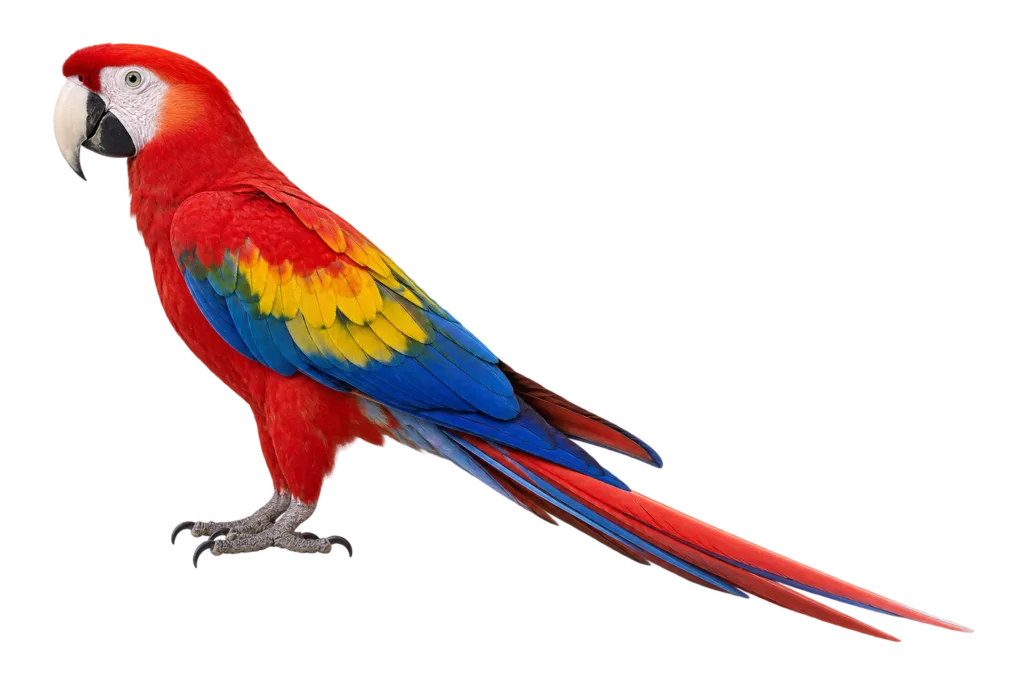
The Scarlet Macaw (Ara macao) is a large parrot whose size is easy to misread. Adult references commonly place total length around 84–89 cm (33–35 in), while body mass is often close to 1 kg and may fall within a broader reported range of roughly 900–1,490 g (2.0–3.3 lb). Much of that apparent length comes from the bird’s exceptionally long, tapered tail rather than a proportionally massive body.
Much of the Macaw’s Length Is Behind Its Body
Total length in a Scarlet Macaw runs from the front of the bird to the tip of the longest tail feathers. This matters because the tail forms a large part of the adult silhouette. A perched bird can therefore measure almost as long as some heavier macaws while looking noticeably slimmer through the chest and body.
The long graduated tail is one of the features that defines the bird’s proportions. Its narrow feathers extend well beyond the folded wings and create the familiar elongated profile. The head is large, the neck appears short, and the powerful bill adds visual bulk at the opposite end, but neither contributes as much to overall length as the tail.
A Scarlet Macaw listed at about 85 cm long should not be pictured as having an 85 cm torso. The measurement includes the head, body and long tail. Weight gives a better indication of how much physical bulk is contained within that length.
This also explains why photographs can make Scarlet Macaws seem dramatically different in size. A tail directed downward may make a perched bird look very tall, while the same bird viewed horizontally can appear much longer and slimmer.
Its Weight Puts the Length Into Perspective
A commonly cited reference value for the Scarlet Macaw is about 85 cm (33.1 in) in length and 1,060–1,123 g (37.1–39.3 oz) in weight. Other species-level descriptions use a wider mass range, so a single weight should not be treated as the expected value for every adult.
The relationship between length and mass becomes clearer when the Scarlet Macaw is compared with other large macaws. The Red-and-green Macaw (Ara chloropterus) is commonly listed near 90 cm and can weigh more than 1.3 kg. The Hyacinth Macaw (Anodorhynchus hyacinthinus) reaches about 90–100 cm and commonly weighs around 1.2–1.45 kg.
The Scarlet Macaw therefore belongs firmly among the large macaws, but its long profile does not make it the heaviest. Birds with similar total lengths can have noticeably different chest depth, head size, bill mass and overall build.
The Northern Subspecies Is Larger
Scarlet Macaws are currently divided into two recognized subspecies: Ara macao macao and Ara macao cyanoptera. Their geographic ranges differ, and research supports a real morphological distinction between them rather than treating every Scarlet Macaw as identical in size.
Ara macao macao
The nominate form occurs from parts of Central America southward into South America. It is generally the smaller of the two forms. Its wing coloration can also include green between the yellow and blue areas of the upper wing, although plumage varies between individuals.
Ara macao cyanoptera
The more northerly A. m. cyanoptera, associated with populations from Mexico and northern Central America, has a larger build. Studies used in the recognition of this subspecies found longer wing measurements than in A. m. macao. It also tends to show little or no green between the yellow and blue portions of the wing.
This subspecies difference helps explain why reputable references do not always give exactly the same dimensions for the species. A measurement taken from one geographic population may not describe the full range of adult Scarlet Macaws elsewhere.
Morphological studies of Scarlet Macaws often report wing chord, which measures the folded wing. That value cannot be substituted for wingspan. A wingspan should be reported only when it has been measured or documented as wingspan rather than estimated from folded-wing measurements.
Males and Females Overlap Strongly in Size
Adult male and female Scarlet Macaws look very similar. There may be individual differences in bill dimensions, tail length or general build, but the sexes overlap too much for overall body size to provide a dependable visual distinction.
A large individual is therefore not automatically male, and a smaller individual is not automatically female. Geographic variation, normal individual variation and the way the bird is positioned can all affect how large it appears.
This is especially relevant in photographs. Feather condition, posture and perspective can change the apparent width of the body, while the bill can look much larger when photographed from slightly in front of the bird. Side-profile views provide a cleaner impression of actual proportions.
Young Birds Have a Shorter-Looking Profile
Juvenile Scarlet Macaws resemble adults in general body form, but their tails are shorter. As the long adult tail is such a major part of total visible length, a young bird may appear considerably more compact even when its basic body proportions already resemble those of an adult.
Adult birds also have light yellow eyes, while younger birds have darker or greyer eyes. These age-related traits are useful when interpreting photographs because a shorter-tailed individual should not automatically be treated as a naturally small adult.
How to Interpret the Scarlet Macaw’s Size
The most useful way to visualize a Scarlet Macaw is as a large-bodied parrot with an unusually extended tail. The bird has a substantial head, a deep hooked bill and broad folded wings, yet the tail stretches the outline far beyond the main body.
A full-body scale comparison should therefore preserve the entire tail when using published total length. Cropping or shortening the tail makes the bird appear smaller than the measurement represents. Conversely, treating the published total length as body height makes it look much larger and bulkier than a real Scarlet Macaw.
Weight adds the missing sense of volume. An adult around one kilogram has considerable mass, but it is distributed through a streamlined flying body rather than an upright, heavy frame. The combination of a strong head and bill, broad wings and a long narrow tail is what gives Ara macao its distinctive scale.
Data
Measurement sources
- Data status
- Measured
- Size measurements
- AVONET — Tobias et al. (2022)
- Morphology source
- AVONET — Tobias et al. (2022)
- Morphology dataset
- AVONET v7 — BirdLife taxonomy
- Morphology dataset license
- CC BY 4.0
Full source links, dataset definitions, licensing details and measurement methodology are maintained on the Data Sources & Methodology page.